Monday, August 8, 2011

History of Ramadhan


History of RAMADHAN

The origin of "Ramadan", the sacred Muslim occassion, can be traced partly to historic accounts as well as the various holy Islamic texts. A great part of the history of Ramadan depends on ancient Islamic folklore.

According to the Islamic texts, Ramadan began with Prophet Muhammad, the founder of Islam who was born in 570 CE in the Arabian city of Mecca. Orphaned at a young age, Muhammad was reared by his uncle Abu Talib. The boy grew up to be a merchant, as well as a shepherd. He was first married by age 25.

Gradually Muhammad began to be dissatisfied with his life in Mecca. Having an idealistic and religious temperament from his very early days, he retreated to the caves in the surrounding mountains of Mecca for meditation and reflection.

According to Islam, one night during the month of Ramadan in the year 610 A.D. when Muhammad was 40 years of age and was passing the month in meditation in Mount Hira, he had a vision of an angel appearing before him. This angel introduced himself as Jibril and revealed that Muhammad was the messenger of Allah and was born to be a prophet to his people. The angel asked Muhammad to recite what he said:

"Recite in the name of your Lord Who creates.
Creates man from a clot.
Recite: And your Lord is the Most Bountiful
Who teaches by the pen,
He teaches man what he does not know."

With a confounded mind, Muhammad descended from Mount Hira and told everything to his wife Khadijah. He feared that he had had an encounter with an evil spirit. But Khadijah allayed his fears reminding him of his good conduct until then and that it was impossible for him to be visited by a demon. She took him to her old cousin Waraqa ibn Nawfal and told the latter everything about Muhammad's meeting with the angel. Waraqa ibn Nawfal was a much learned man and was well-versed in various sacred texts concerning different religion. The lettered man convinced Muhammad that he was indeed a messenger of God and the angel who visited Muhammad was the same divine messenger Gabriel who had also visited the Hebrew prophet Moses.

In the following twenty-three years, Muhammad was visited many times by Jibril who taught him the holy knowledge in verses. This sacred knowledge consists of the code of conduct that Allah wants his people to maintain on earth. It is inscribed in verses which are compiled in the holy Qur'an, the most sacred book in Islam.

It is said that the sacred knowledge was revealed to Muhammad during the month of Ramadan. "Laylat al-Qadr" - a night of the month is symbolically regarded as the same night on which the holy knowledge was gifted to Muhammad and mankind. The followers of Islam consider "Laylat al-Qadr" as the "Night of the Power", the holiest night of the year.

As a mark of respect to Allah and to show gratitude to him for the true knowledge that he gifted to his sons and daughters, the prophet asked his followers (and therefore the followers of Islam) to pass the month of Ramadan in fasting, prayers and other austerities and end the month-long non-indulgence with festive celebrations.

The Quran instructs us:
"Ramadan is the month during which the Quran was revealed, providing guidance for the people, clear teachings, and the statute book. Those of you who witness this month shall fast therein. Those who are ill or traveling may substitute the same number of other days. Allah wishes for you convenience, not hardship, that you may fulfill your obligations, and to glorify Allah for guiding you, and to express your appreciation." [Surat Al-Baqarah 2:185]

Thus was born the sacred occassion called Ramadan, a month-long period of austerity that sees devout Muslims across the world keep themselves away during the entire daytime, offering prayers and abstaining from almost every kind of enjoyment including drinking and abstaining from sex. For Muslims all over, it is a very special time - of introspection, meditation, self control, charitable activities, and spirituality and of course, devotion to God.

Friday, August 5, 2011

Benefits of Dates Fruit for Women and Men

Benefits of Dates Fruit for Women and Men

Dates are highly nutrient dense foods. They provide large quantities of dietary fiber, dates calcium, iron, sulfur, potassium, manganese, phosphorus, copper, and magnesium. These essential nutrients are needed for optimum health.

  • Dates provide instant energy and boost stamina and tolerance levels.
  • Dates work wonderfully for the GI tract. It combats the most stubborn case of constipation and bowel irregularity. It reduces the transit time of stool within the colon.
  • Beta glucan found in dates is very good for diabetes.
  • It prevents spiking and excessive oscillation of the blood sugar level.
  • Dates check the multiplication of worms and parasites in the bowel, and promote the growth of the friendly, beneficial bacteria.
  • Dates are used to treat anemic conditions.
  • It manages anemic headaches, breathlessness and dizziness successfully.
  • Dates also promote healthy heart functioning. The fruit checks a range of cardiovascular diseases.
  • Research also says that dates contain powerful anti-oxidants that ward off cancers by fighting the free radicals.

Thursday, August 4, 2011

THE MORE YOU GIVE- THE MORE YOU GET


Bismillahirrahmanirrahim.

In this special Ramadan, MRC had planned a few program in order to enlighten this month. One of the program that will be done is a charity visit to old folk's home. So here, MRC NILAI really appreciate if there anybody who want to donate some of their belongings such as money, clothes and others which will be contributed to those less fortunate old folks.

A few members of MRC NILAI had visited them ( first visit ) last week to make a floor plan, making a few preparation and meet with it's founder, Puan Muji. She was a nurse at Hospital Serdang before this. She said that many of the old folks that staying in this charity home were taken from the hospital.

RUMAH JAGAAN & RAWATAN ORANG TUA AL IKHLAS really need support from us.

Insya Allah later, we will share the further information and story after been there, on this 21st August and will be participated by all MRC's committee.. Those who would like to give some donation, you may to do so by referring to us ( MRC NILAI ). Thank you.

RAMADAN KAREEM!

Wassalam.

The Virtues of Fasting

Assalamualaikum,

The virtues of fasting are great indeed, and one of the things reported in the Sahih hadith is that Allah has chosen fasting for Himself, and He will reward it and multiply the reward without measure, as He says : Except for fasting which is only for My sake, and I will reward him for it.

Fasting has no equal , and the du'a of the fasting person will not be refused

The fasting person has two moments of joy: one when he breaks his fast and one when he meets his Lord and rejoices over his fasting .

Fasting will intercede for a person on the Day of Judgement, and will say, O Lord, I prevented him from his food and physical desires during the day, so let me intercede for him.

The smell that comes from the mouth of a fasting person is better with Allah than the scent of musk.

Fasting is a protection and a strong fortress that keeps a person safe from the Fire.

Whoever fasts one day for the sake of Allah, Allah will remove his face seventy years distance from the Fire.

Whoever fasts one day seeking the pleasure of Allah, if that is the last day of his life, he will enter Paradise. In Paradise there is a gate called al-Rayyaan, through those who fast will enter, and no one will enter it except them; when they have entered it will be locked, and no-one else will enter through it.

Ramadan is a pillar of Islam; the Qur'an was revealed in this month, and in it there is a night that is better than a thousand months. When Ramadan begins, the gates of Paradise are opened and the gates of Hell are closed, and the devils are put in chains.

Fasting Ramadan is equivalent to fasting ten months.

Whoever fasts Ramadan out of faith and with the hope of reward, all his previous sins will be forgiven.

At the breaking of every fast, Allah will choose people to free from Hellfire.

Tuesday, August 2, 2011

Teen

Our mother gave birth to us to be a muslim


Time passing year by year

You learn a new way of life


Then what happen to the next generation???


One day I was crying when my mother dint buy me a new toys......


You never think about other people in other country. When we eating Nasi Ayam we want to get better food. When we see people buying a new handphone , we want a better phone for us.


Do we ever thank to Allah for everything that we get???


You always crying when your parents reject your request. But do you think that you never make your mother crying?? Even if one tears drop from your mother eyes how much sin that you get???


OH ALLAH PLEASE GAVE MY BLESSING TO MY PARENTS... Make me a humble person that thankfull every Rezki that you gave to me....

Monday, August 1, 2011

RAMADHAN HEALTH

The fast of Ramadan is rigorous, particularly during long summer days when it may be required to resist all food and drink for as many as sixteen hours at a time. This strain may be too much for people with certain health conditions.

The Qur'an instructs Muslims to fast during the month of Ramadan, but also gives clear exemptions for those who may become ill as a result of fasting:

"But if any of you is ill, or on a journey, the prescribed number (of Ramadan days) should be made up from days later. For those who cannot do this except with hardship is a ransom: the feeding of one that is indigent.... Allah intends every ease for you; He does not want to put you to difficulties...." - Qur'an 2:184-185
In several other passages, the Qur'an instructs Muslims not to kill or harm themselves, or cause harm to others.

Prior to Ramadan, a Muslim should always consult with a doctor about the safety of fasting in individual circumstances. Some health conditions may be improved during fasting, while others may possibly deteriorate. If you decide that fasting could possibly be harmful in your situation, you have two options:

  • If yours is a temporary, not chronic, condition you may make up the fast (a day for a day) at a later time, when your health improves.
  • If yours is a permanent or chronic condition, you may make a donation in charity in lieu of fasting. The amount should be sufficient to feed one person a day, for each fasting day that is missed.
There is no need to feel guilty about taking care of your health needs during Ramadan. These exemptions exist in the Qur'an for a reason, as Allah knows best what issues we may face. Even if one is not fasting, one can feel part of the Ramadan experience through other areas of worship -- such as offering additional prayers, inviting friends and family for evening meals, reading the Qur'an, or donating to charity.

Additional information is available below for those with specific health concerns. Again, you should always consult with your own doctor to evaluate your individual circumstances.

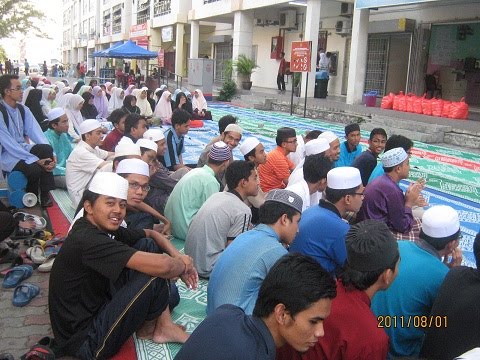
Opening Ceremony Ihya' Ramadan 2011 & Iftor Jama'i

Assalamualaikum

Event's Name: Opening Ceremony Ihya' Ramadan 2011 & Iftor Jama'i
Date: 1/8/2011
Time: 6:30 pm - 8:00pm
Vanue: Blue Court Block B
Special Guest: UST MOHD BAHRODDIN BIN BADRI, Principle of MARA