Assalamualaikum,
The virtues of fasting are great indeed, and one of the things reported in the Sahih hadith is that Allah has chosen fasting for Himself, and He will reward it and multiply the reward without measure, as He says : Except for fasting which is only for My sake, and I will reward him for it.
Fasting has no equal , and the du'a of the fasting person will not be refused
The fasting person has two moments of joy: one when he breaks his fast and one when he meets his Lord and rejoices over his fasting .
Fasting will intercede for a person on the Day of Judgement, and will say, O Lord, I prevented him from his food and physical desires during the day, so let me intercede for him.
The smell that comes from the mouth of a fasting person is better with Allah than the scent of musk.
Fasting is a protection and a strong fortress that keeps a person safe from the Fire.
Whoever fasts one day for the sake of Allah, Allah will remove his face seventy years distance from the Fire.
Whoever fasts one day seeking the pleasure of Allah, if that is the last day of his life, he will enter Paradise. In Paradise there is a gate called al-Rayyaan, through those who fast will enter, and no one will enter it except them; when they have entered it will be locked, and no-one else will enter through it.
Ramadan is a pillar of Islam; the Qur'an was revealed in this month, and in it there is a night that is better than a thousand months. When Ramadan begins, the gates of Paradise are opened and the gates of Hell are closed, and the devils are put in chains.
Fasting Ramadan is equivalent to fasting ten months.
Whoever fasts Ramadan out of faith and with the hope of reward, all his previous sins will be forgiven.
At the breaking of every fast, Allah will choose people to free from Hellfire.
Thursday, August 4, 2011


Tuesday, August 2, 2011
Teen
Our mother gave birth to us to be a muslim

Time passing year by year

You learn a new way of life

Then what happen to the next generation???
One day I was crying when my mother dint buy me a new toys......


You never think about other people in other country. When we eating Nasi Ayam we want to get better food. When we see people buying a new handphone , we want a better phone for us.
Do we ever thank to Allah for everything that we get???

You always crying when your parents reject your request. But do you think that you never make your mother crying?? Even if one tears drop from your mother eyes how much sin that you get???
OH ALLAH PLEASE GAVE MY BLESSING TO MY PARENTS... Make me a humble person that thankfull every Rezki that you gave to me....
Monday, August 1, 2011
RAMADHAN HEALTH
The fast of Ramadan is rigorous, particularly during long summer days when it may be required to resist all food and drink for as many as sixteen hours at a time. This strain may be too much for people with certain health conditions.
The Qur'an instructs Muslims to fast during the month of Ramadan, but also gives clear exemptions for those who may become ill as a result of fasting:
"But if any of you is ill, or on a journey, the prescribed number (of Ramadan days) should be made up from days later. For those who cannot do this except with hardship is a ransom: the feeding of one that is indigent.... Allah intends every ease for you; He does not want to put you to difficulties...." - Qur'an 2:184-185In several other passages, the Qur'an instructs Muslims not to kill or harm themselves, or cause harm to others.
Prior to Ramadan, a Muslim should always consult with a doctor about the safety of fasting in individual circumstances. Some health conditions may be improved during fasting, while others may possibly deteriorate. If you decide that fasting could possibly be harmful in your situation, you have two options:
- If yours is a temporary, not chronic, condition you may make up the fast (a day for a day) at a later time, when your health improves.
- If yours is a permanent or chronic condition, you may make a donation in charity in lieu of fasting. The amount should be sufficient to feed one person a day, for each fasting day that is missed.
Additional information is available below for those with specific health concerns. Again, you should always consult with your own doctor to evaluate your individual circumstances.
Opening Ceremony Ihya' Ramadan 2011 & Iftor Jama'i


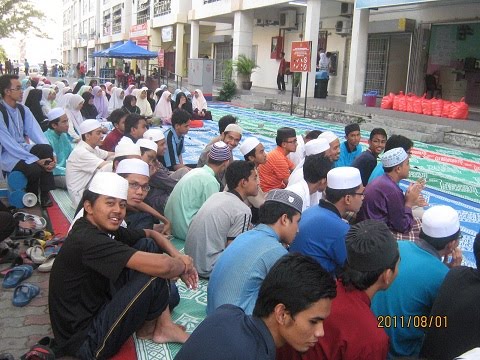


Sunday, July 31, 2011
Ramadhanu Kareem.
Blessings of the month of Ramadhanul Mubarak
Fasting is the fourth pillar of Islam. The word "Sawm " (meaning to stop or abstain) is used in Arabic for fasting. A fast then means that one refrains from eating, drinking and other physical things (all those things that are otherwise allowed) from dawn to sunset. This month comes every year to spread the blessings and mercy of Allah. We are thankful to Allah for providing physical forms of divine worship such as prayer, fasting, and pilgrimage to improve our moral and spiritual condition.
Welcoming the Month of Ramadhan: The Holy Prophet (peace and blessings of Allah be upon him) has said: "The month of Ramadhan comes to you. This is a blessed month" (Kitab-ul-Saum). The Holy Prophet (peace and blessings of Allah be upon him) has declared this month as the "month of Allah" because one abandons all otherwise "lawful" things in the way of Allah. He has also declared this month as the "Chief of the months." Worship during this month gains more blessings so one should fast with sincere intentions and worship should be performed to win Allah's pleasure.
Ramadhan - Anniversary of the Holy Quran: Ramadhan is that blessed month in which the Holy Quran was first revealed to the Holy Prophet (peace and blessings of Allah be upon him). In this regard this month celebrates the birthday of the Holy Quran. To render our dues we should recite the Holy Quran as much as possible. During this month, at night, the Holy Prophet (peace and blessings of Allah be upon him) use to recite the Holy Quran in its entirety with the Angel Gabriel (Jibraeel).
Opening the doors to heaven: Hazrat Abu Hurairah (may Allah be pleased with him) has narrated that the Holy Prophet (peace and blessings of Allah be upon him) said: "When the month of Ramadhan starts, the doors of heaven are opened, the doors of the hell are closed, and Satan is put into chains" (Sahih Muslim Kitab-ulSaum). In this saying the Holy Prophet (peace and blessings of Allah be upon him) has promised a high place in heaven for one who observess the fast because a believer is enjoined to perform such deeds that please Allah and stay away from bad things.
Ramadhan's Special relationship with Tahajjud Prayers: Hazrat Abu Hurairah, may Allah be pleased with him, narrated that the Holy Prophet, peace be upon him, said: "A person who gets up at night for Prayer and fulfills all requirements of his faith with an intention of receiving blessing during the Month of Ramadhan, is forgiven all his past sins."
Charity during Ramadhan: Ibn Abbas relates that the Holy Prophet, peace be upon him, was the most generous of men and he was at his most bountiful during Ramadhan when Gabriel visited him every night and recited the Quran to him. During this period the bounty of the Holy Prophet, peace be upon him, waxed faster than the rain-bearing breeze (Bokhari and Muslim).
Prayers: Allah forgives all previous sins of a person who sincerely worships Allah during the month of Ramadhan. During this month Allah's mercy and blessings are at their peak. The Holy Prophet (peace and blessings of Allah be upon him) has said that during Ramadhan: "Allah says: 'Is there anyone who calls on me so that I can accept his prayers? Is there anyone who asks for anything so that I can fulfill his desires? Is there anyone who asks for forgiveness so that I can forgive" (Sahih Bukhafi - Kitab-ul-Tauheed).
Last Ten days of Ramadhan: Hazrat Ayesha (may Allah be pleased with her) narrates that, during the month of Ramadhan, the Holy Prophet (peace and blessings of Allah be upon him) used to develop a new vigor, staying awake alI night and also waking members of his family for worship" (Sahih Bukhail, Kitab-ul-Saum). During the month of Ramadhan worship reaches its peak in the form of I'tikaaf (retirement for Allah's worship). The Holy Prophet (peace and blessings of Allah be upon him) used to retire to the Mosque in the last ten days of the Ramadhan. He would go to a corner in the Masjid-e-Nabwee (Prophet's Mosque) to worship Allah in seclusion.
Ramadhan and Lailatul Qadr (Night of Decree): Hazrat Ayesha (may Allah be pleased with her) said: "O Allah's Prophet, if I know which night is the Lailatul Qadr then what should I pray? He replied: 'you should pray: 'O Allah, you are very forgiving and love those who forgive others. So bestow your blessings on me and forgive me"' (Jamiah Tirmidhi, Kitab-Al-Dawat). Lailatul Qadr is such a night that the Holy Quran has declared it to be better than a thousand months. May Allah enable us to be the recipients of Lailatul Qadr that we truly benefit from the coming month of Ramadhan. May Allah accept our prayers. Ameen.
Saturday, July 30, 2011
Ramadan أهلا وسهلا
Assalamualaikum.
Dear Readers,
Ramadan is around the corner. Syukur alhamdullah to Allah S.W.T because let us meet another Ramadan for this year. Who knows this is maybe our last Ramadan? Thus, enjoy the info!
Ramadan (Arabic: رمضان Ramaḍān) is the ninth month of the Islamic Calender, which lasts 29 to 30 days. It is the Islamic month of fasting, in which participating Muslims refrain from eating and drinking during daylight hours and is intended to teach Muslims about patience, spirituality, humility and submissiveness to God. Muslims fast for the sake of God (Arabic: الله, trans: Allah) and to offer more prayer than usual. Compared to the Solar Calendar, the dates of Ramadan vary, moving backwards by about eleven days each year depending on the moon; thus, a person will have fasted every day of the calendar year in 34 years' time. Muslims believe Ramadan to be an auspicious month for the revelations of God to humankind, being the month in which the first verses of the Qur'an were revealed to the Islamic Prophet, Muhammad.
May peace be upon you. salam
-admin
Tuesday, December 7, 2010
forum : MAHASISWA LESU : DILEMMA MINDA TEMPURUNG

FORUM
MAHASISWA LESU : DILEMMA MINDA TEMPURUNG
Tempat:
Tapak Pameran I-Fiesta, UIAM Nilai
Masa:
8.30pm-11.00pm
Panelist:
Ustaz Riduan Mohd Nor - Pengerusi Front Bertindak Anti Murtad (FORKAD) & Muslim Care
Ustaz Shamsul Hakim - Fakulti Pengajian Quran Sunnah, USIM
Moderator:
Ahmad Syazwan Hassan - Mantan Bendahari MPMUM
Subscribe to:
Posts (Atom)